pos-vs-pod-the-process-of-logistics-Bangalore
Understanding POS vs. POD: The Backbone of Transparent Logistics in Bangalore
In business, asking for proof isn't about personal doubt—it is simply the standard process of logistics. From the moment you agree to move goods, establishing a clear, accountable paper trail is what separates legitimate operators from fraudulent players.
Every trade has its own terminology to confirm who your Booking Agent in Logistics is, acting as a legally binding tender from origin to destination.
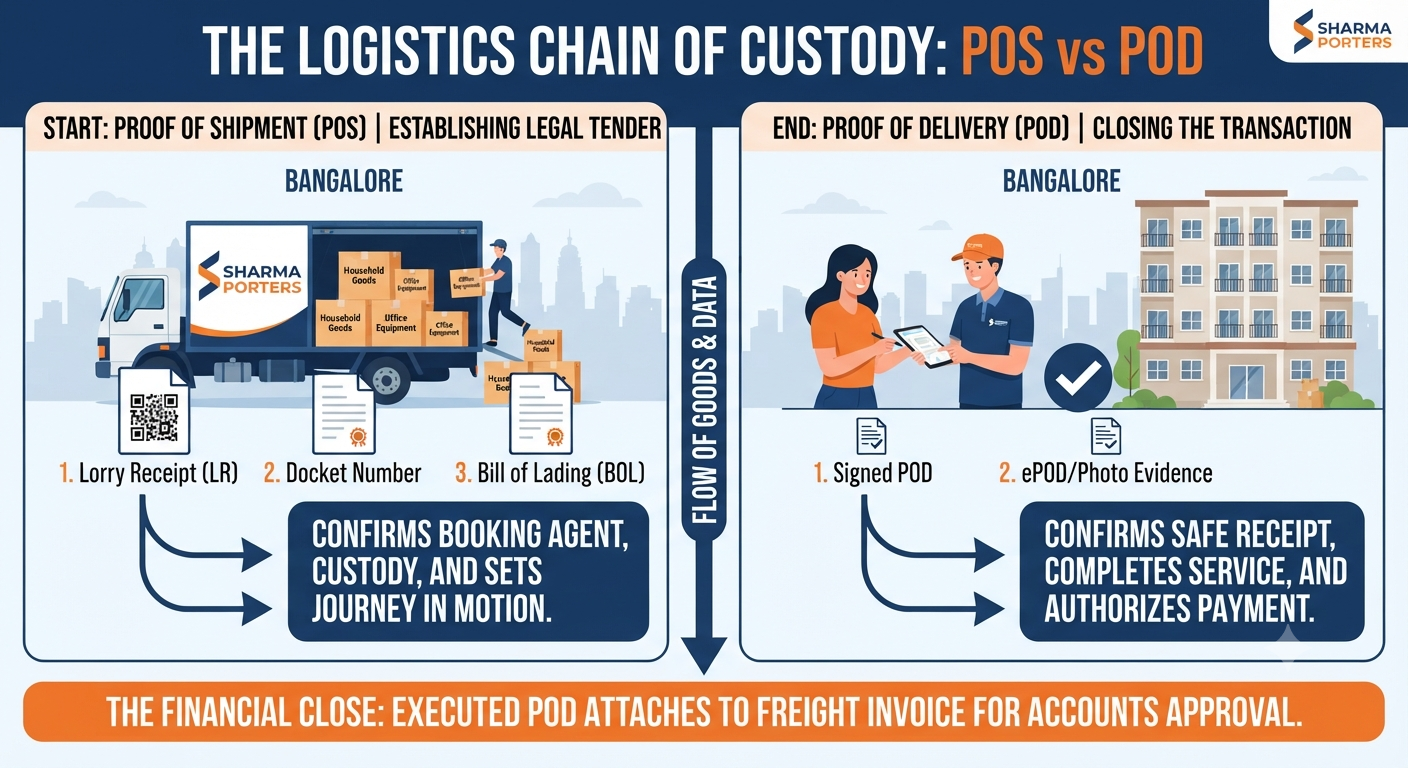
1. The Starting Anchor: Proof of Shipment (POS)
When a consignment is booked and dispatched, the process begins with documentation that proves the carrier has officially taken custody of the goods. Depending on the mode of transport, this goes by different names:
- In Transport: Lorry Receipt (LR)
- In Courier: Docket Number
- In Shipping: Bill of Lading (BOL)
These documents confirm your booking agent, establish legal tender, and set the entire journey in motion.
2. The Final Seal: Proof of Delivery (POD)
Once the shipment reaches its final destination and is handed over safely, the physical transaction concludes with a Proof of Delivery (POD). This guarantees that the receiver has inspected and accepted the consignment, completely closing the door on transit disputes or fake movement claims.
3. The Financial Close: Accounts Approval
A transaction doesn't end on the road; it ends on the balance sheet. For transparent operations, the executed POD is permanently attached to the Freight Invoice as the mandatory green light for Accounts Approval and final payment release.
At Sharma Porters, we believe that strict adherence to POS, verifiable Lorry Receipts, and confirmed PODs are non-negotiable pillars of trust across Bangalore's transport corridors. Take a ride with a logistics partner committed to total accountability.
Logistics Documentation: The Trust & Accountability Q&A
1. Why are transit documents like POS (Lorry Receipts) and POD actually needed?
- Answer: They aren’t just paperwork; they are the physical proof of a legally binding contract. They establish exact ownership, define who the booking agent is, track the physical custody of goods from origin to destination, and protect both the customer and the mover from misunderstandings, lost items, or fraudulent claims.
2. How do these documents provide legal support in case of a dispute or damage?
- Answer: In the event of a dispute, cargo damage, or transit delay, a properly executed Lorry Receipt (POS) and a signed Proof of Delivery (POD) serve as primary legal tender in commercial courts. They clearly outline the agreed-upon terms, the condition of goods at pickup, and explicit acceptance at delivery, making it legally difficult for rogue operators or scammers to deny responsibility.
3. How does a strict documentation process help build and scale a business?
- Answer: Transparency is the ultimate market differentiator. When a logistics company implements an unbroken paper trail—from verifiable booking receipts to POD-backed invoices—it builds immediate credibility with corporate clients and everyday movers. It eliminates grey areas, speeds up financial audits, and fosters long-term customer loyalty by proving absolute reliability.
4. Why is the POD required for Accounts Approval before releasing payments?
- Answer: The signed POD acts as the final verification that the service contract has been successfully fulfilled. For corporate accounts and finance departments, attaching the POD to the Freight Invoice provides the mandatory audit trail required to clear payments legally, ensuring funds are only released for completed, verified work.
5. How do these standard processes protect consumers from moving scams in Bangalore?
- Answer: Fraudulent movers and "ghost offices" typically rely on vague verbal agreements, cash-only transactions, and a complete lack of official documentation. By insisting on a formal POS (like an official Lorry Receipt) at the start and a verified POD at the finish, consumers completely shut down the loopholes that rogue operators use to disappear with goods or levy hidden charges.
Gallery