paid-vs-to-pay-vs-credit-payment-logistics-bangalore
Paid vs. To-Pay vs. Credit Payment Models in Logistics: Mastering Working Capital
Navigating payment terms is one of the most critical operational hurdles for any transport business owner. While every transporter would ideally prefer 100% upfront payment upon pickup, the reality of commercial logistics demands a strategic approach to managing cash flow, credit cycles, and risk.
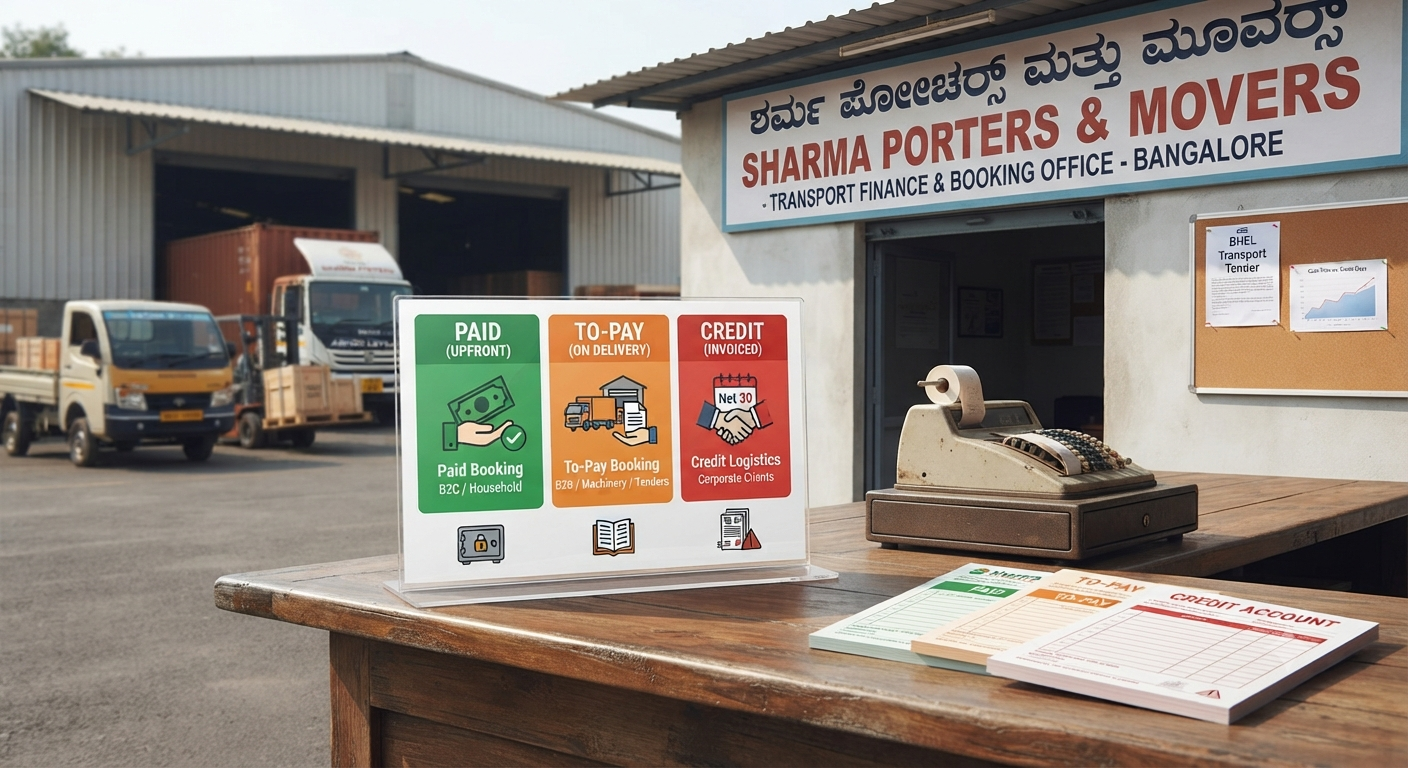
1. Paid Booking (Upfront Payment)
-
The Model: Payment is collected entirely upfront before the shipment is picked up.
-
Common Use Cases: Widely standard in B2C logistics and household relocations by packers and movers where parties to the transaction are unfamiliar with each other. Homeowners moving residential goods frequently utilize Paid Bookings.
-
Industry Norms: Similar to railways, bus parcel services, and courier networks, this eliminates credit default risk entirely.
2. To-Pay Booking (Payment on Arrival)
-
The Model: Once the shipment is loaded, the receiver (consignee) agrees to pay the freight charges upon arrival at the destination before unloading commences.
-
Transporter's Role: The transporter must finance the initial trip expenses (such as driver advances and fuel) to cover transit costs, recovering the balance upon delivery.
-
Heavy Industrial & Government Tenders: Commonly used for moving kitchen equipment, bakery machinery, rice milling units, and CNC machines. Notably, many public sector and government consignments operate on a "To-Pay" freight basis at the consignee site (such as various BHEL transportation consignments).
3. Credit Logistics (The High-Stakes Working Capital Game)
-
The Model: The booking contractor mutually agrees to extend a credit facility to established corporate clients in exchange for higher profit margins and long-term business volume.
-
The Reality of Credit Terms: While official agreements typically range from 7 to 30 days, customer payment delays frequently stretch cycles out to 45 to 60 days.
-
The Payment Trap: Many transport operators fall into severe cash flow crunches trying to compete on credit terms. Surviving this requires robust financial backing—such as bank credit lines, internal cash flow, Overdraft (OD) facilities, or strategic credit leverage with local petrol pump owners for fuel.
-
The Corporate Leverage Dynamic: Large manufacturers often leverage their market dominance to demand extended vendor credit from transporters while squeezing transport margins, making payment recovery the single hardest part of running a logistics business.
10 Essential Q&A: Logistics Payment Terms & Cash Flow Management
Q1: Why do most transporters prefer a Paid Booking model? A: Paid bookings secure 100% upfront payment upon pickup, completely eliminating default risk and protecting the transporter's working capital.
Q2: Where is the Paid booking model most commonly applied? A: It is standard in B2C logistics, courier services, and residential relocations managed by packers and movers where the parties involved do not have an established credit history.
Q3: How does a To-Pay booking function operationally? A: The shipment is loaded and transported using the operator's initial funds, and the receiver pays the total freight charges upon the goods' arrival at the destination before unloading.
Q4: What types of machinery and industrial goods frequently move on a To-Pay basis? A: Heavy industrial apparatuses such as CNC machines, rice milling equipment, bakery machinery, and commercial kitchen setups.
Q5: Do government or public sector bodies utilize To-Pay freight arrangements? A: Yes. Many government and industrial tenders (including specific public sector manufacturing consignments) operate on a pay-basis where freight is cleared directly by the consignee at the project site.
Q6: What is the standard agreed-upon credit window in Credit Logistics? A: Formal credit terms usually range between 7 days to 30 days, though they frequently stretch to 45 or 60 days in practice.
Q7: Why do transport business owners often fall into the "payment trap"? A: To stay competitive, operators agree to extend long credit terms to clients without adequate working capital reserves, making cash recovery extremely difficult.
Q8: How do seasoned fleet owners finance operations while waiting for credit recovery? A: They utilize banking facilities (such as OD limits), maintain internal cash reserves, or leverage credit relationships with local petrol pump owners for operational fuel expenses.
Q9: How do large manufacturers impact transport credit cycles? A: Big manufacturing firms often leverage their size to withhold higher transport margins while demanding extended credit from transport vendors to run their own operations.
Q10: Where can transport operators find further guidance on logistics business strategy? A: Fleet owners can explore scaling tips and operational frameworks through Sharma Porters and the Mission Sena Navigation portal.
Our Founder Jeethendra Sharma actively guides logistics operators through working capital challenges, GBP optimization, and strategic transport planning. Explore more insights via the Mission Sena Navigation portal.
Gallery