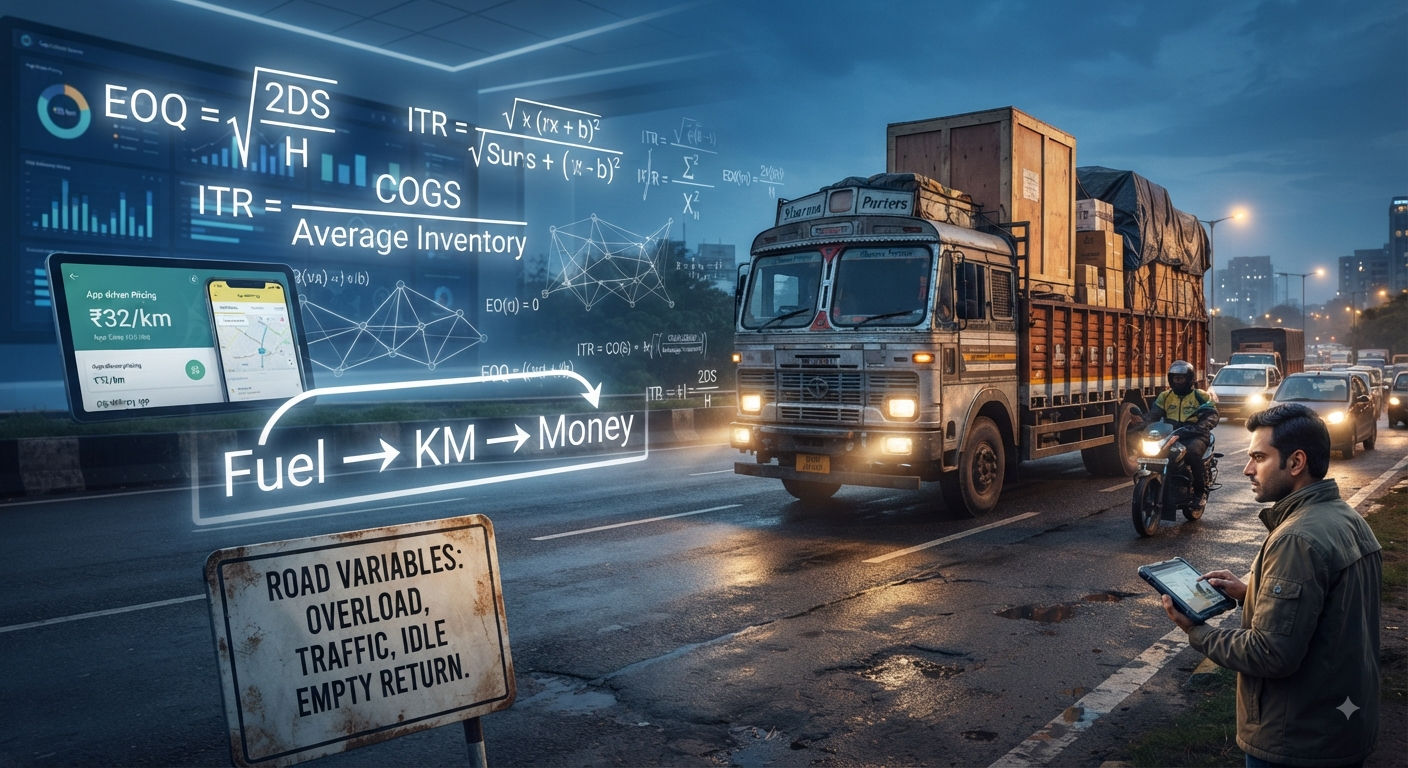
modern mathematical logistics equation
The New Sharma Logistics Equation: 25 Years on the Asphalt vs. The Boardroom
After 25 years of sweating it out on the front lines of logistics and moving—navigating every broken highway, dealing with phantom ghost listings during our ground audits across Bangalore, and watching legacy models collapse—here is the raw truth: Every single classroom formula and board-room theory has failed.
When you've spent a quarter of a century running packers, movers, and heavy transport, you realize that static textbook models belong on a dusty shelf. In this New Logistics Era, apps dictate the price with algorithmic cruelty, and volatile vehicle variants (from gig-delivery EVs to heavy commercial trucks running on mixed fuels) make standardizing operations harder than ever.
It is time to rewrite the formula. Here is the operational decode after 25 years in the trenches.
Part 1: The Core Economic Loop (Fuel $\rightarrow$ KM $\rightarrow$ Money)
No matter the scale, platform, or vehicle type (petrol, EV, CNG, or ethanol blends), logistics always boils down to a single brutal loop:
$$\text{Fuel/Energy} \longrightarrow \text{Kilometers Covered} \longrightarrow \text{Revenue Generated}$$
-
Energy Input: Upfront capital investment in power or fuel to move the machine.
-
Distance Utilization: Profit is driven by asset utilization. Every idle kilometer is a dead loss; every rolling kilometer moves you toward revenue.
-
Margin Optimization: The ultimate goal is minimizing cost-per-kilometer while maximizing revenue-per-kilometer.
When corporations or government bodies issue transport tenders, they almost universally award the contract to the L1 (Lowest Bidder). Winning relies entirely on engineering the lowest cost-per-kilometer through smart energy choices, efficient route optimization, and strategic bidding.
Part 2: Why Classroom Formulas Tear Up on the Road
Static equations look great on paper, but after 25 years on the asphalt, I can tell you they crumble against reality:
-
Truck Overload: A shifting payload that changes tire wear, suspension strain, and fuel burn instantly.
-
Tight Delivery Windows & Speed Demands: When deadlines force you to push equipment past its limits, fuel consumption skyrockets.
-
Empty Return Trips: Delivering a load with zero backhaul cargo means losing a full day and burning capital with zero incoming revenue.
-
The App-Driven Pricing Trap: Digital aggregators and real-time bidding apps dictate price ceilings instantly, leaving zero room for human error or miscalculated overhead.
-
Vehicle Variant Chaos: Managing a mixed fleet of two-wheelers, three-wheelers, EVs, and heavy trucks introduces compounding maintenance and energy variances that static spreadsheets cannot predict.
Part 3: The Mathematical Pillars of Supply Chain
Behind the chaos of the road, mathematics still forms the foundational architecture when adapted for reality:
1. Inventory Management: Economic Order Quantity (EOQ)
Calculates the exact amount of inventory to order to minimize ordering and storage costs.
$$\text{EOQ}=\sqrt{\frac{2DS}{H}}$$
-
$D$ = Annual Demand (Units sold per year)
-
$S$ = Order Cost (Fixed setup/shipping fee per order)
-
$H$ = Holding Cost (Cost to store one unit for a year)
2. Risk Mitigation: Reorder Point (ROP)
Determines when to place a new order to avoid stockouts during lead times.
$$\text{ROP}=(d\times L)+\text{SS}$$
-
$d$ = Average Daily Demand
-
$L$ = Lead Time (Supplier delivery days)
-
$SS$ = Safety Stock (Buffer inventory for emergencies)
3. Warehousing: Inventory Turnover Ratio (ITR)
Measures how efficiently stock is sold and replaced over a period.
$$\text{ITR}=\frac{\text{COGS}}{\text{Average\ Inventory}}$$
4. Transport: Vehicle Capacity Utilization (CU)
Calculates cargo loading efficiency to eliminate costly empty space.
$$\text{CU}=\left(\frac{\text{Actual\ Payload\ Volume\ or\ Weight}}{\text{Maximum\ Vehicle\ Capacity}}\right)\times 100$$
Part 4: The Hidden Math Behind "The Loop"
While traditional classroom formulas fail against unpredictable road variables, successful operators know that a dynamic framework can still be calculated. The operational ethos of "Fuel the Kilometers, Win the Tenders, Maximize the Margin" is expressed as a quantitative Operational Efficiency Index ($EE_i$):
Efficiency Index ($EE_i$) Formula:
$$EE_i = \frac{\text{Revenue per Kilometer} - \text{Energy Cost per Kilometer}}{\text{Fixed Overhead per Asset Mile}}$$
To stay profitable against algorithmic app pricing, fleet operators must ensure $EE_i > 1$. Achieving this requires dynamic route planning that completely eliminates unutilized cargo space and deadhead miles.
11 Q&A: The Old vs. New Logistics Equation (A Veteran’s Decode)
Q1: What was the core premise of the old logistics equation in traditional supply chain management?
A: The old equation relied on static, textbook assumptions where logistics was viewed as a predictable, linear calculation. It assumed that theoretical models like Economic Order Quantity (EOQ) and static routing could cleanly dictate costs on paper without factoring in the chaos of real-world variables.
Q2: How does the new logistics era redefine the foundational economic loop?
A: The new era strips logistics down to its rawest economic engine:
$$\text{Fuel/Energy} \longrightarrow \text{Kilometers Covered} \longrightarrow \text{Revenue Generated}$$
. It measures success entirely by how efficiently a machine is fueled, how many productive kilometers are squeezed out of it, and how cost-per-kilometer is minimized against revenue-per-kilometer.
Q3: Why do traditional classroom formulas fail on the asphalt today?
A: Classroom formulas assume ideal conditions, whereas real-world operations face unpredictable variables like truck overloads that instantly alter tire wear and fuel burn, tight delivery windows that force machines to be over-driven, and empty return trips that burn capital with zero backhaul revenue.
Q4: What role do digital apps play in pricing within the new logistics era?
A: In the old era, pricing was largely negotiated based on long-term contracts and static cost-plus models. In the new era, apps dictate the price instantly with algorithmic precision, leaving zero margin for human error, miscalculated overhead, or sluggish response times.
Q5: How do mixed vehicle variants complicate modern transport management?
A: Unlike legacy fleets running standard fuel, modern fleets feature a chaotic mix of gig-delivery two-wheelers, three-wheelers, EVs, CNG systems, and heavy commercial trucks on mixed fuel blends. This introduces compounding maintenance and energy variances that static spreadsheets cannot predict.
Q6: Why do lowest-bidder (L1) transport tenders still succeed, and how has the strategy changed?
A: Corporations and government bodies still award contracts to the lowest bidder because fuel and energy constitute the largest variable operating expense. However, winning tenders today requires advanced energy arbitrage—optimizing fuel efficiency, securing bulk or green energy rates, and right-matching vehicles to specific routes.
Q7: How has inventory management shifted from theory to practice?
A: While old models like EOQ and Reorder Point (ROP) provided a mathematical baseline for inventory and safety stock, modern operations must dynamically adjust these calculations in real time to prevent stockouts caused by sudden supply chain bottlenecks, app-driven demand spikes, and unpredictable transit delays.
Q8: What makes asset utilization the ultimate benchmark of profitability?
A: Every kilometer a vehicle sits idle is a direct fixed cost bleeding capital; every rolling kilometer moves the operator closer to revenue. Maximizing daily productive kilometers is the only way to dilute depreciation, insurance, and maintenance overhead in a hyper-competitive market.
Q9: How does warehouse management bridge mathematical theory with asphalt reality?
A: Warehousing uses mathematical principles like queuing theory and linear programming to optimize layouts and picking paths. However, its true efficiency is tested on the other side of the dock door—how quickly those packed goods transition onto a truck that can navigate real-world traffic without blowing its delivery window.
Q10: What is the ultimate takeaway of transitioning from the old equation to the new?
A: Logistics is no longer an abstract art piece for boardrooms or academic textbooks. Survival and profitability in the modern era belong to those who master the asphalt, respect the harsh variables of the road, outsmart algorithmic app-pricing, and live by the ultimate operational rule: Fuel the Kilometers, Win the Tenders, Maximize the Margin.
Q11: How can operators mathematically prove profitability against algorithmic app pricing in the new era?
A: Operators use the Operational Efficiency Index ($EE_i$), which measures the spread between revenue and energy costs per kilometer relative to fixed overhead per asset mile:
$$EE_i = \frac{\text{Revenue per Kilometer} - \text{Energy Cost per Kilometer}}{\text{Fixed Overhead per Asset Mile}}$$
To survive and thrive, a fleet must maintain $EE_i > 1$ by ruthlessly eliminating deadhead miles and unutilized cargo space through real-time route optimization.
The Bottom Line
After 25 years in the business, I can tell you that logistics is no longer just about moving boxes—it is a high-stakes collision between rigid mathematical frameworks, ruthless app-driven pricing, and unpredictable road variables. Master the asphalt, optimize your fuel-to-kilometer ratio, and outsmart the algorithm.
Fuel the Kilometers, Win the Tenders, Maximize the Margin. Take a ride.
Want to optimize your supply chain with brilliant basics? Feel free to get in touch.
Gallery