The Alternative Law of Logistics
The Alternative Law of Logistics in Bangalore: Breaking Dependency, Maximizing Choice
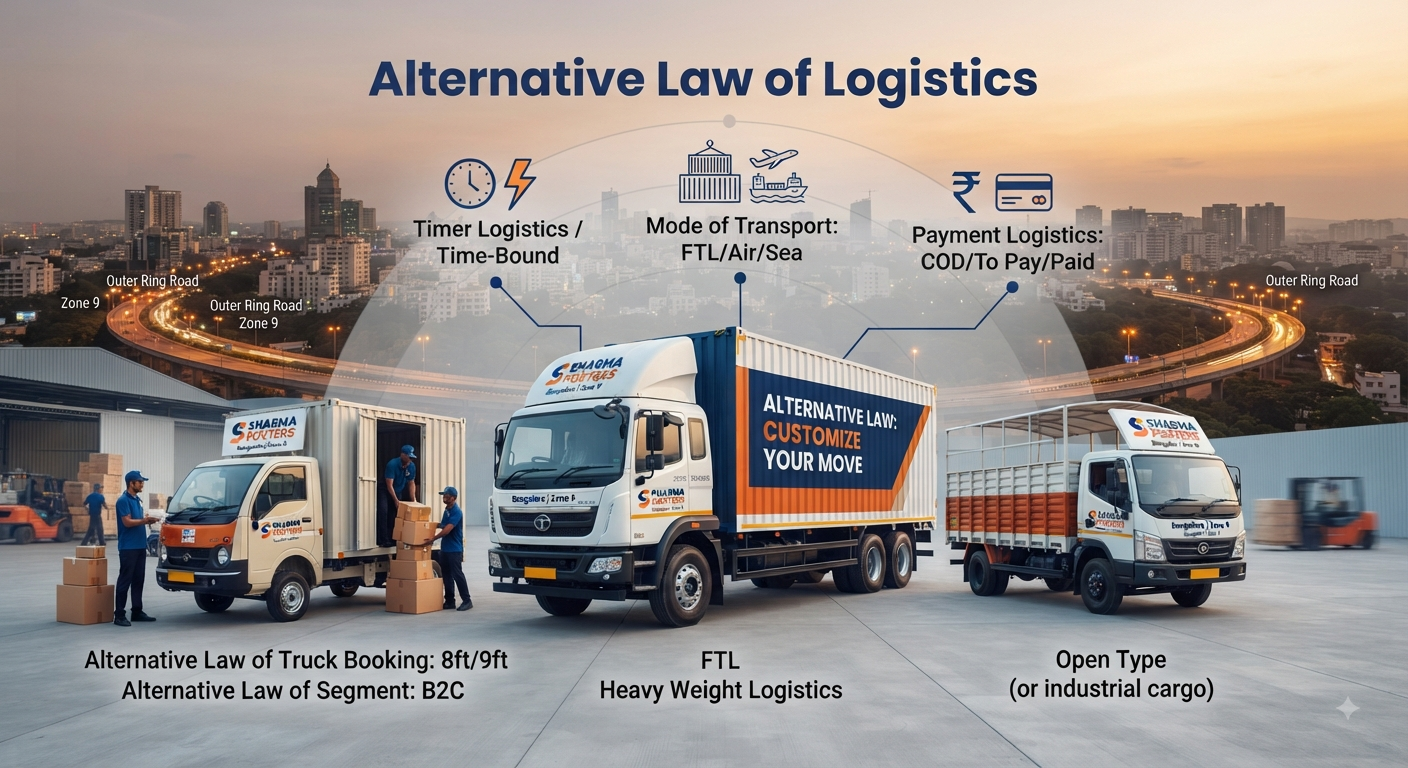
Logistics has traditionally operated under the law of alternatives: having multiple vendor partners to maintain a steady flow of business and eliminate single-point dependency. At Sharma Porters, we are taking that concept and completely breaking it down into a granular science of customer choice for both packers & movers and general transport services.
When you ship with us across Bangalore and Zone 9, you aren't just booking a truck—you are taking complete control of your supply chain through our Seven Pillars of Logistics Alternatives.
1. Alternative Law of Mode of Transportation
Every shipment has a unique DNA. Depending on your urgency and budget, you get to choose your primary mode:
- Air Transportation
- Sea Transportation
- Railway Transportation
- Truck Transportation
2. Alternative Law of Truck Booking (Surface Transport)
If you opt for surface transportation, the choices multiply. Decide between LCL (Less than Container Load) or FTL (Full Truck Load) shipments, and pick the exact vehicle size that fits your payload:
- Lengths: 8 ft, 9 ft, 10 ft, 14 ft, 17 ft, 19 ft, 21 ft, 24 ft, and 32 ft.
- Body Types: Open Type or Closed Container Type.
3. Alternative Law of Weight Logistics
Capacity shouldn't be a guessing game. Select your trucks based on the exact weight you wish to transport, ranging from light payloads to heavy industrial cargo:
- 500 Kgs
- 1000 Kgs
- 3000 Kgs
- 5000 Kgs
- 9000 Kgs
- 19000 Kgs
- 21000 Kgs and more.
4. Alternative Law of Route Logistics
Why let a third party dictate your transit? You get to choose and review the route alternatives you want the truck to take for your specific consignment.
5. Alternative Law of Timer Logistics
When shipments demand strict time-bound delivery, we deploy specialized routing and expedited truck arrangements designed for the fastest possible transit.
6. Alternative Law of Payment Logistics
Flexibility extends right down to your cash flow. Choose the payment structure that suits your business model:
- Paid Basis: Book upfront to optimize and save on transportation costs.
- To Pay / COD (Cash on Delivery): Have your consignee clear the freight charges securely at the destination.
7. Alternative Law of Segment Logistics
Logistics serves two entirely different worlds, and we cater seamlessly to both:
- B2C Segments: One-time transport and household relocation requirements.
- B2B Segments: Regular, daily fleet requirements for businesses and manufacturers.
The Takeaway: Modern logistics is built on the choices the customer makes. Whether you need a single 8-foot closed container in Bangalore or a continuous B2B fleet deployment, Sharma Porters puts every alternative directly in your hands.
Q1: How does this "Alternative Law of Logistics" post actually help everyday customers and businesses?
A: It removes the guesswork and rigidity from shipping. Instead of forcing customers into a one-size-fits-all pricing or vehicle model, this post educates users on how they can customize every single parameter of their move—from vehicle size and weight capacity to payment terms and routes—giving them complete transparency and control over their logistics budget.
Q2: What kind of residential or commercial packers and movers services can be booked here?
A: Customers can book complete household shifting, office relocations, localized shifting within Bangalore and Zone 9, single-item transport, and heavy commercial goods moving. Services cover both delicate household packing and robust industrial loading.
Q3: Which law should a customer choose if they are shifting a 1-BHK or 2-BHK household within Bangalore?
A: The Alternative Law of Truck Booking combined with the Alternative Law of Segment Logistics (B2C). For instance, a customer can choose an 8-ft or 10-ft closed container vehicle for safe, weather-proof residential relocation.
Q4: Which alternative law applies if an e-commerce business or manufacturer needs trucks every single day?
A: The Alternative Law of Segment Logistics (B2B Segment). It is designed precisely for businesses that require regular, recurring fleet deployment rather than one-time transport.
Q5: If a client has urgent, high-value cargo that needs to beat standard delivery timelines, what law should they rely on?
A: The Alternative Law of Timer Logistics. This law focuses on time-bound delivery, fast transit routing, and expedited truck arrangements to ensure shipments arrive right on schedule.
Q6: What services can be booked under the Alternative Law of Mode of Transportation?
A: Customers can choose their primary transport channels based on urgency and budget, ranging from Truck Transportation (for surface and local/regional movement) to Air, Sea, and Railway Transportation for long-distance or multi-modal supply chains.
Q7: How does the Alternative Law of Weight Logistics help companies transporting heavy industrial machinery?
A: It allows businesses to precisely match their payload with the right truck capacity—whether they are moving 500 Kgs of fragile goods or heavy consignments scaling from 5,000 Kgs up to 21,000 Kgs and more, preventing under-utilization or overloading.
Q8: Which law governs whether the sender or the receiver pays for the freight charges?
A: The Alternative Law of Payment Logistics. It provides financial flexibility by offering Paid Basis (upfront booking to save costs) or To Pay / COD (Cash on Delivery) where the freight charges are collected securely from the consignee at the destination.
Q9: What moving scenario is best suited for LCL versus FTL shipments under the truck booking law?
A:
- LCL (Less than Container Load): Best for smaller loads where you only pay for the exact space your goods occupy.
- FTL (Full Truck Load): Best for large-scale household shifting or bulk commercial inventory where you require an entire 14-ft, 24-ft, or 32-ft truck dedicated solely to your consignment.
Q10: How does the Alternative Law of Route Logistics benefit specialized cargo transport in Bangalore?
A: It gives businesses and consignors the ability to review and choose optimal routing alternatives, ensuring that sensitive or time-sensitive shipments navigate through the city and across Zone 9 efficiently while avoiding bottlenecks.
Gallery