Logistics Trucks demand vs supply freight charges
Truck Demand vs Supply: How Return Loads Shape Freight Charges | Sharma Porters
Unlocking Freight Truth: How Demand, Supply, and Return-Load Realities Shape Truck Charges
In the logistics industry, headlines often romanticize supply chain metrics, but ground-level operators know the raw, unvarnished truth: Demand drives sales, and sales dictate price. When you look past corporate press releases, freight charges are never dictated by arbitrary numbers. They are forged in the fires of operational reality—specifically, the structural balance between booming cargo demand, lagging fleet supply, and the notorious trap of return-load inefficiencies.
1. The Core Mechanics: Truck Demand vs. Supply
At its most basic level, a logistics network operates on a simple economic tightrope:
- Truck Demand: The total volume of freight waiting to be moved across city corridors and regional highways.
- Truck Supply: The actual pool of operational commercial vehicles and trained drivers ready for deployment.
When demand outstrips supply, shipping rates climb. When supply overwhelms demand, prices drop. However, this classical economic formula has a massive wild card that standard textbooks miss: The Return-Load Factor.
2. The Real Cost of an Empty Return: Why No One Wins
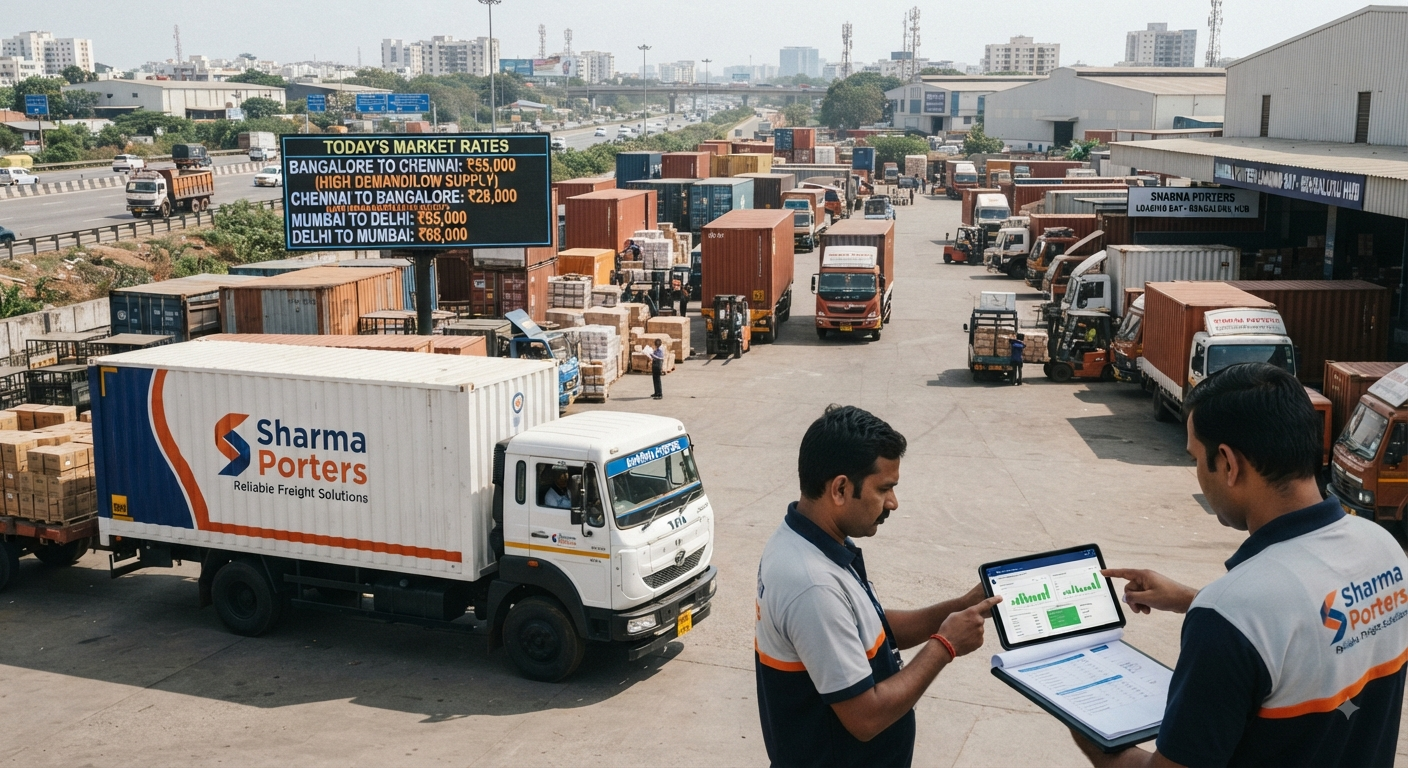
Consider a practical, high-stakes scenario familiar to any transporter operating across industrial corridors like Bangalore and Chennai:
If there is a massive commercial demand for 20-foot closed container trucks originating out of Bangalore to drop cargo in Chennai, but zero backhaul demand returning from Chennai to Bangalore, the economic equation breaks down:
- The Deadhead Penalty: The truck must run empty (deadhead) all the way back or sit idle waiting for cargo, delaying its turnaround time.
- The Origin Market Pays: Because the transporter cannot afford to absorb the cost of a fuel-burning empty return trip, they must price the outbound leg high enough to subsidize the round trip.
- The Ripple Effect: As seen during peak agricultural movements—such as the Nashik onion harvest where demand surged 45% while truck availability dropped 30% due to return-load bottlenecks—the lack of return cargo strangles turnaround times and forces freight rates through the roof.
At the end of the day, no one wins:
- The Transporter suffers from low fleet utilization and wasted fuel.
- The Shipper gets slammed with penalty-inflated freight tariffs.
- The End Consumer ultimately pays higher prices for everyday goods because of structural transport waste.
3. Demand & Supply Trends in Indian Trucking
3.1 Freight Demand Trends
- India’s Road Freight Growth: Total road freight demand is projected to reach 4.8 trillion ton-km by 2030, up sharply from 2.2 trillion ton-km in 2023 (Source: NITI Aayog, National Logistics Policy 2024).
- E-Commerce Expansion: E-commerce shipments are projected to grow at a 28% CAGR, hitting 15 billion shipments annually by 2030 (Source: RedSeer Consulting).
- Container Traffic: India's export-import container traffic grew 9.2% YoY in Q1 2024 (Source: Indian Ports Association, April 2024).
Sector-Wise Demand Breakdown:
- Manufacturing & Exports: Merchandise exports touched $778 billion in FY 2023-24, heavily driving the need for Full Truckload (FTL) and containerized transport (Source: Ministry of Commerce & Industry).
- Agri & Cold Chain: Demand for reefer trucks surged 32% YoY due to perishables, dairy, and pharmaceuticals (Source: NITI Aayog Cold Chain Report 2024).
- Construction & Infrastructure: Road infrastructure spending increased 12.3% in 2024, spiking project cargo trucking demand (Source: Union Budget 2024-25).
3.2 Supply-Side Challenges & Operational Pressures
- Fleet Constraints: India counts 2.8 million trucks, but annual fleet growth sits at a meager 1.9%, severely lagging behind demand. Furthermore, the vehicle replacement rate dropped from 4% to 2.8%, resulting in an aging fleet and higher downtime.
- Driver Deficit: The industry faces a 22% shortage of truck drivers, representing a deficit of 1.2 million drivers that directly constrains active freight capacity.
- Escalating Costs: Diesel prices rose 18% YoY, accounting for 50-55% of operating expenses, while toll costs jumped 15% following the NHAI's revision.
4. Real-World Case Studies: When Demand-Supply Gaps Break the Chain
Case Study 1: Agricultural Trucking Crisis in Maharashtra
- The Problem: During Nashik’s onion harvest season, demand surged 45%, but truck availability dropped 30% due to return-load bottlenecks.
- The Impact: Freight rates skyrocketed by 30%, making exports unviable, while farmers lost over ₹500 crore due to delayed shipments.
- The Solution: Deployment of dynamic truck routing and return-load incentives by regional stakeholders reduced transit inefficiencies and cut transport costs by 25%.
Case Study 2: E-Commerce Festive Rush & Urban Bottlenecks
- The Problem: During the festive season rush, major platforms experienced an 80%+ surge in demand, but chronic truck shortages and urban access restrictions throttled deliveries.
- The Impact: Spot freight rates spiked 40%, and failed delivery rates climbed 15%.
- The Solution: Adopting short-term truck leasing, night-time delivery windows, and dynamic pricing curbed delivery failures by 30%.
Case Study 3: Port Congestion at Nhava Sheva (JNPT)
- The Problem: Imbalanced import-export container flows and severe truck shortages triggered 7 to 10-day shipment delays.
- The Impact: Exporters absorbed over ₹500 crore in detention and demurrage penalties.
- The Solution: Shifting volume to rail-road multimodal transport cut direct truck dependency by 35% and restored flow velocity.
5. Strategies for Pricing & Procurement Teams
To survive and scale amidst volatile freight economics, businesses must move away from reactive booking and adopt systematic frameworks:
- Demand Forecasting & Capacity Planning: Integrate AI-based forecasting to anticipate seasonal harvest and festive surges ahead of time, locking in long-term carrier contracts to hedge against rate spikes.
- Smart Hybrid Pricing: Combine fixed and spot-rate models to balance cost predictability with market flexibility, offering guaranteed commitments to secure dedicated fleet capacity.
- Technology-Driven Optimization: Leverage modern logistics marketplaces and AI-driven route planning tools to minimize empty return miles (deadheading) and slash unnecessary fuel and toll expenditures.
- Multimodal Infrastructure: Shift long-haul cargo corridors toward rail-road-water hybrid models to insulate operations from highway truck deficits.
6. Conclusion: The Road Ahead with Sharma Porters
The Indian trucking sector stands at a critical crossroads between explosive cargo demand and stubborn supply-side constraints. Whether moving high-value retail goods across metropolitan corridors or heavy agricultural produce out of regional hubs, surviving market fluctuations requires absolute transparency, data-backed procurement, and efficient return-load management.
At Sharma Porters, we cut through the industry noise to deliver reliable, end-to-end logistics solutions that account for ground-level realities. Take a ride and drive your supply chain forward with confidence!
10 Q&A: How Every Business Runs on Demand and Supply—With Logistics as No Exception
Q1: What is the fundamental economic principle that governs all business operations?
A: Every business fundamentally operates on the law of demand and supply. Demand represents what customers or markets want to buy, while supply represents the goods, services, or capacity a business provides to fulfill those needs. Price, profitability, and market survival are constantly balanced by this equilibrium.
Q2: Why is the logistics and trucking sector no exception to the rule of supply and demand?
A: Logistics is entirely governed by the same economic mechanics because transportation capacity is a finite resource. When cargo freight demand (goods needing movement) outstrips truck supply (available vehicles and drivers), shipping rates and spot prices surge. When supply exceeds demand, freight rates drop.
Q3: How do unbalanced lanes and return-load inefficiencies distort basic freight pricing?
A: In logistics, a truck delivering goods from Point A to Point B often faces a "deadhead" or empty return trip if there is no backhaul cargo from Point B back to Point A. Because the transporter must absorb the cost of the fuel-burning empty return leg, the origin market pays a penalty, driving up the initial freight charges to subsidize the round trip.
Q4: What real-world example illustrates how return-load bottlenecks cause market failures?
A: During Nashik’s onion harvest season, demand for agricultural transport surged by 45%, but truck availability dropped by 30% due to return-load bottlenecks. This supply-demand friction caused freight rates to jump 30%, making exports unviable and resulting in massive financial losses for producers.
Q5: In the context of supply-side constraints, what major pressures are currently impacting Indian trucking?
A: The Indian trucking sector faces severe supply-side bottlenecks, including:
- A meager 1.9% annual fleet growth rate that heavily lags behind surging cargo demand.
- A 22% shortage of truck drivers (a deficit of 1.2 million drivers).
- Escalating operating expenses, including an 18% YoY rise in diesel prices and a 15% hike in toll costs.
Q6: How do macroeconomic demand trends, such as e-commerce and manufacturing, dictate logistics pricing?
A: Exploding consumer demand—such as e-commerce shipments growing at a 28% CAGR and merchandise exports touching $778 billion—creates massive, concentrated spikes in freight volume. When these volume spikes hit highway networks faster than fleets can expand, spot freight pricing spikes drastically.
Q7: Why do traditional economic models of supply and demand fail to capture the full picture in freight transport?
A: Standard textbooks assume a clean, instant transaction between buyers and sellers. In logistics, the Return-Load Factor acts as a wild card. A truck is not just moving in one direction; its economic viability depends entirely on securing a return load. Without it, turnaround times collapse, creating artificial scarcity even if total truck counts look high on paper.
Q8: When supply-demand imbalances cause freight market spikes, who ultimately bears the cost?
A: No one wins. Transporters suffer from low fleet utilization and wasted fuel on empty runs; shippers get slammed with penalty-inflated freight tariffs; and the end consumer ultimately pays higher retail prices for everyday goods because of structural transport waste.
Q9: How can modern businesses and procurement teams insulate themselves from volatile freight demand and supply gaps?
- Demand Forecasting & Capacity Planning: Utilizing AI-based forecasting to anticipate seasonal harvest or festive surges ahead of time.
- Smart Hybrid Pricing: Combining fixed and spot-rate models to balance cost predictability with market flexibility.
- Technology Optimization: Leveraging logistics marketplaces and automated route planning to minimize empty return miles.
- Multimodal Infrastructure: Shifting long-haul freight to rail-road-water hybrid corridors.
Q10: How does Sharma Porters address the core realities of demand, supply, and transparency in logistics?
A: Sharma Porters cuts through industry noise and hidden friction by maintaining rigorous verification frameworks, direct vehicle ownership networks, and transparent rate structuring. By aligning ground-level operational realities with data-driven logistics solutions, it ensures reliable, end-to-end transport for every client.
Gallery