365 24 7 logistics working cycle bangalore
Sharma Porters: Why Bangalore Transport Owners and Movers Must Rework Their 365-Day Strategy
At Sharma Porters, we believe that logistics is not just about moving boxes from point A to point B—it is a strict mathematical equation. When you run a logistics and relocation service in a fast-paced market like Bangalore, understanding calendar math is the difference between sustainable growth and sudden asset bleed.
For the complete framework and operational deep-dive, explore our core resource on the 365-24-7 Logistics Working Cycle.
1. The Calendar Arithmetic: The Hidden Cost of Idleness
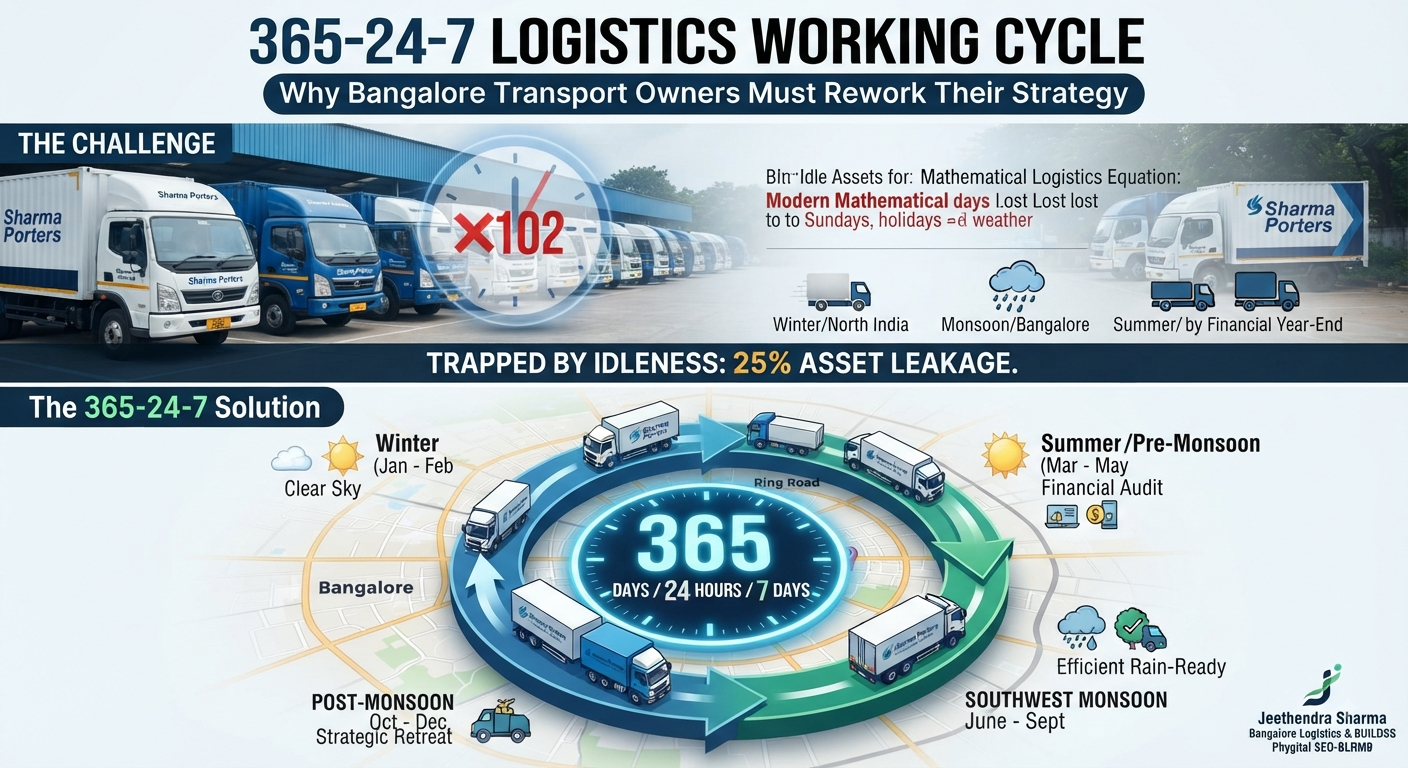
A standard year consists of 365 days, but effective working days are heavily chipped away by scheduled downtime:
- Non-Working Days: 52 Sundays + 17 Gazetted Holidays + 33 Restricted/Festive Holidays = 102 non-working or low-efficiency days (varying by region and operations).
- Net Operating Days: Roughly 263 to 280 working days remain.
- The Impact for Sharma Porters & Operators: Trucks, transport fleets, and material handling equipment sit idle or operate at sub-optimal capacity for nearly 25% to 30% of the year. Fixed costs—such as vehicle EMIs, insurance, depreciation, and driver retention—continue to accrue regardless, quietly eroding profit margins.
2. Seasonal Volatility & Regional Disruptions
India's diverse climate introduces distinct operational bottlenecks across the four traditional seasons:
- Winter (January – February): Dense fog paralyzes North India (Delhi, Punjab, Haryana, UP, Rajasthan, MP, HP, J&K), severely restricting transit speeds, increasing turnaround times (TAT), and spiking highway accident risks.
- Summer / Pre-Monsoon (March – May): Coincides with corporate financial year-end closures and audits, causing erratic demand surges followed by sudden lulls as businesses reconcile accounts.
- Southwest Monsoon (June – September): Heavy rainfall causes widespread urban waterlogging and highway congestion nationwide—disrupting intercity and intracity transit times.
- Post-Monsoon / Retreating Monsoon (October – December): Swollen rivers trigger severe flooding in East India (West Bengal, Bihar, Assam), forcing costly route diversions and key transport corridor closures.
3. Margin Compression and Market Pressures
Beyond weather and calendar math, transport operators navigate fierce industry headwinds:
- Freight Wars: Intense rate undercutting squeezes operating margins across the board.
- Rising Input Costs: Fuel price volatility and toll expenses make accurate long-term budgeting a major challenge.
The Sharma Porters Approach: Strategic Takeaways
To protect profit margins and overcome structural idleness, logistics owners must transition from reactive firefighting to proactive management:
- Dynamic Fleet Deployment: Shift focus to regional corridors less impacted by seasonal vagaries during peak disruption windows.
- Predictive Analytics: Utilize weather tracking and route-optimization software to anticipate transit delays before they occur.
- Value-Added Services: Diversify revenue streams by offering warehousing, value-added packaging, contract logistics, and verified packers and movers services to offset periods of low freight demand.
10 Q&A on Scaling and Reworking Logistics with Sharma Porters
1. Why 24/7 & 365 Days Is Not Enough for a Logistics Business?
- Answer: Operating around the clock does not solve structural downtime if your assets are sitting idle during the 102 non-working days (holidays, Sundays, and weather-disrupted windows). Without strategic flexibility, working 24/7 just means burning fixed overhead costs faster during seasonal slumps.
2. Why Transport Businesses Do Not Work for 1/3 of a Year?
- Answer: Regional weather bottlenecks (such as dense North Indian fog and monsoon waterlogging) combined with mandatory public holidays, festival closures, and corporate financial year-end audits create an enforced period where logistics assets are paralyzed for nearly a third of the year.
3. How Sharma Porters Added More Services to Avoid the Logistics Trap?
- Answer: By diversifying beyond basic point-to-point transit into specialized lines like heavy box cargo delivery, Move-A-Box solutions, IT equipment transport, and multi-layer packing services, Sharma Porters broadens its utility. Explore these capabilities directly on the Sharma Porters Porter Services Page.
4. Why Truck Rental & Moving Service Can Be a Good Mix in Logistics Business?
- Answer: Combining asset rental with end-to-end relocation services bridges the gap between commercial fleets and household consumers. This dual model ensures that trucks are not restricted to one revenue stream, smoothing out demand fluctuations between individual household moves and commercial corporate contracts.
5. Why a "Packers and Movers Specialist" Is Not Enough?
- Answer: Relying strictly on traditional household shifting leaves a business vulnerable to seasonal shifts and intense market rate undercutting. Modern operators must integrate parcel delivery, light cargo transport, and commercial B2B support to stay resilient year-round.
6. Why Sharma Porters Started Focusing on South India Logistics Service?
- Answer: Concentrating on high-efficiency regional corridors across Karnataka, Tamil Nadu, Andhra Pradesh, Telangana, and Kerala allows Sharma Porters to bypass weather patterns like North Indian fog while serving high-density manufacturing and IT hubs. Learn more about this regional expansion through the Sharma Porters South India Transport Network.
7. How Event Logistics Business Supports Logistics Revenue?
- Answer: Event logistics—such as transporting wedding luggage, catering materials, stage setups, and concert LED equipment—operates on a distinct calendar from standard corporate freight. This injects high-value, time-sensitive revenue streams during weekends and festive seasons when routine commercial transport might be slow.
8. Being a 3PL Company Can Help Generate Revenue?
- Answer: Operating as a Third-Party Logistics (3PL) provider enables businesses to manage end-to-end warehousing, inventory management, and distribution for multiple clients under long-term contracts, replacing volatile spot-market freight with predictable recurring income.
9. How One-Way Logistics Service Helps Sharma Porters Add More Clients?
- Answer: One-way transport models give shippers the flexibility to pay only for the transit distance they use without paying for empty return legs. This cost-efficient approach attracts budget-conscious retail clients, students, and small businesses looking for transparent local moving solutions.
10. How the Bangalore-Chennai-Bangalore Corridor Drives Truck Efficiency for Sharma Porters?
- Answer: The Bangalore-Chennai corridor connects two of South India's largest industrial and technological powerhouses via well-maintained national highways. This high-frequency route allows Sharma Porters to minimize empty return miles (deadheading), ensuring trucks maintain rapid turnaround times and maximum asset utilization.
Gallery